Tattoo Aftercare Without Petroleum: Why Your Artist Is Wrong (Sorry)
Share
Your tattoo artist gave you Bepanthen or Aquaphor and told you to use it for two weeks. Follow that. Tattoo artists know the raw healing window better than anyone, and the petroleum-based products they recommend have a long, validated track record for the first 14 days when ink is fresh, the skin is open, and infection is the only thing that matters.
This article isn't about that window. This is about the next forty years.
Once your tattoo has fully closed and the artist's care plan ends (usually around week three), most people stop thinking about tattoo care entirely. They go back to whatever moisturiser they had. Some don't moisturise the tattooed skin at all. The tattoo fades, blurs, loses contrast, and the colour shifts faster than it needs to.
Petroleum was right for week one. It's not right for year one, year five, or year fifteen. Here's what tattooed skin actually needs once it's healed, and why the products that protected the wound aren't the ones that preserve the ink.
First, the boundary
To be completely clear:
-
Days 1 to 14 (raw healing phase): Follow your artist's instructions. Use whatever they recommended. Petroleum-based products like Aquaphor and Bepanthen are clinically validated for fresh ink and we have nothing to add to that conversation.
-
Week 3 onwards (post-raw, healed phase): This is where this article lives. Once your tattoo has closed, scabbing is complete, and your skin has reformed across the dermal ink layer, you're in maintenance territory.
If you're not sure whether you're past the raw phase, ask your artist. The defining markers are: scabs fully released without picking, no weeping, no ongoing tenderness, skin texture returning to normal across the tattooed area.
Why post-raw maintenance actually matters
The raw phase is about not getting infected. The post-raw phase is about how your tattoo looks in five, ten, twenty years.
Three things age tattoos faster than time itself:
1. UV exposure
Sunlight breaks down tattoo pigment. UV radiation degrades ink particles, fades colours, shifts hues (reds and purples first, then yellows and greens), and accelerates the migration of ink particles within the dermis. This isn't theoretical. It's the single most well-documented cause of tattoo fading.
Daily SPF 30 or higher over tattooed skin is non-negotiable. Cloudy days included. Winter included. The damage accumulates.
2. Barrier dysfunction
Skin with elevated transepidermal water loss (TEWL) looks less vibrant. The same ink under a hydrated, intact barrier reads as more saturated than the same ink under dry, compromised skin. Daily barrier care isn't cosmetic. It's how your tattoo keeps looking like your tattoo.
3. Mechanical stress
Tattooed skin still ages, stretches, dries, and reacts to friction. The areas where you tattoo (knees, elbows, hands, ribs, hips) are often high-friction zones that didn't have any specific care strategy before the ink was there. Adding a friction-reduction layer to those areas extends ink life.
Where petroleum stops being the right answer
Petroleum is excellent at one thing: occlusion. It seals. For an open wound in the raw healing phase, that's exactly what you want.
For healed skin in long-term maintenance, occlusion has tradeoffs:
-
Doesn't absorb. Sits on the surface, transfers to fabric, leaves clothes greasy.
-
Doesn't deliver actives. Petroleum is biologically inert. Once the wound is healed, you want ingredients that support skin function, not just sit on it.
-
Doesn't layer well under sunscreen. The most important post-raw product is SPF. Petroleum compromises sunscreen application.
-
Doesn't address ongoing barrier needs. Healed tattooed skin still loses water, still reacts to environment, still needs lipid support. Petroleum doesn't deliver any of that.
This isn't a knock on what your artist recommended. It's a recognition that the right tool for week one isn't the right tool for year five.
What healed tattooed skin needs
Daily moisture support without grease
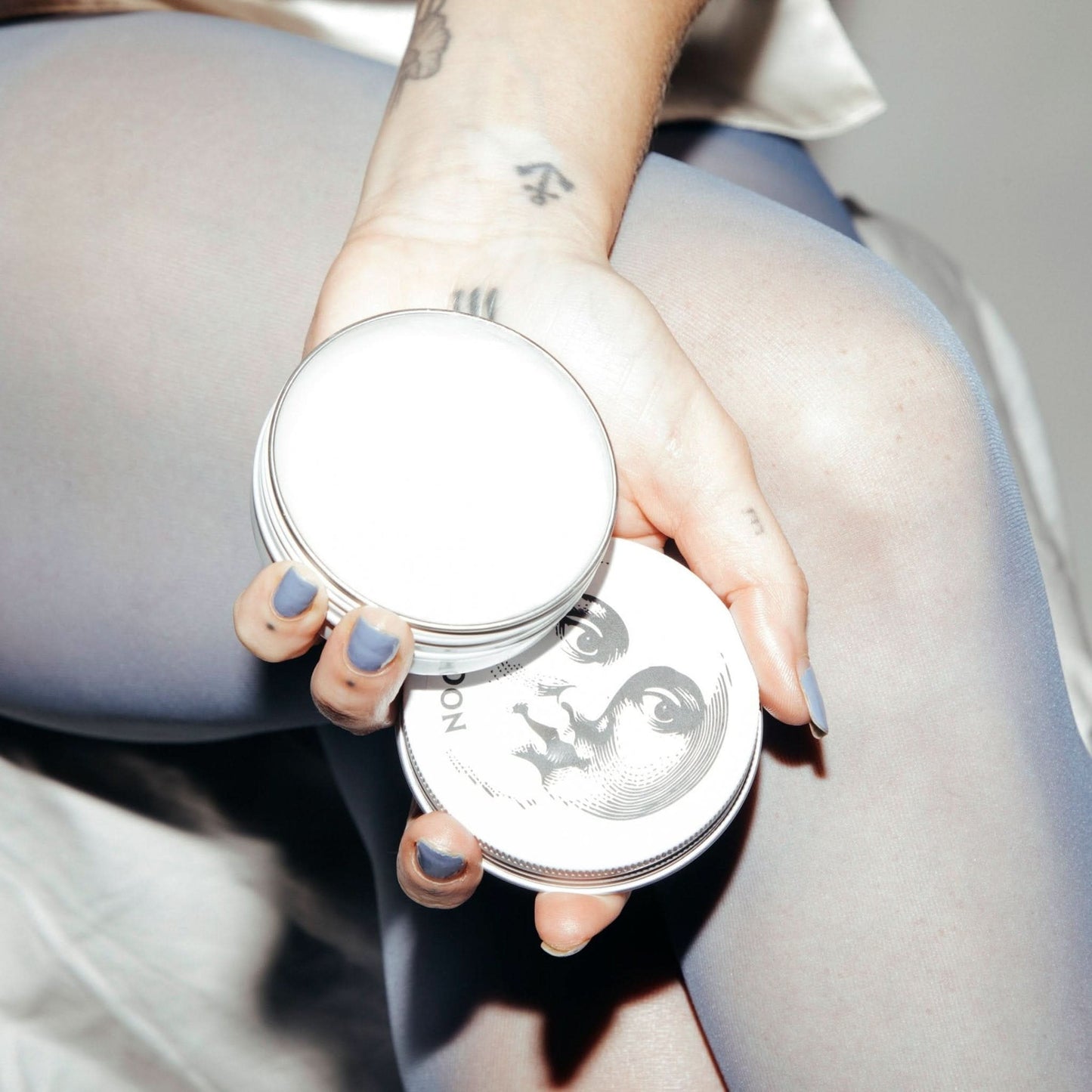
An anhydrous balm with a fast absorption profile (60 to 90 seconds) that integrates into the lipid matrix rather than sitting on top. The Everywhere Balm absorbs cleanly, leaves a soft-matte finish, and doesn't transfer to fabric. Apply once or twice a day to keep tattooed skin supple.
Compatibility with sunscreen
Whatever you put on tattooed skin in the morning has to layer cleanly under SPF. Heavy occlusives interfere with sunscreen film formation. The Everywhere Balm absorbs fully before sunscreen application. Apply balm first, wait 60 to 90 seconds, apply SPF 30+ over the top.
Friction reduction in high-wear areas
Marshmallow root in the formula creates a friction-reducing surface layer that helps fabric glide over tattooed skin instead of catching. Useful for tattoos on knees, elbows, ribs, and any area where clothing repeatedly contacts the skin.
Anti-inflammatory support for sensitive tattoos
Some tattoos remain reactive long after they're healed. Old red ink occasionally flares. UV exposure can trigger temporary irritation. Calendula and bisabolol in the Everywhere Balm provide anti-inflammatory support without suppressing skin function.
The simple post-raw routine
Once your tattoo is fully healed (week 3 onwards):
-
Cleanse normally. Tattooed skin doesn't need special cleansers anymore. Whatever gentle, fragrance-free cleanser you use for the rest of your body is fine.
-
Apply the Everywhere Balm to dry skin. A thin layer over and slightly beyond the tattooed area. Wait 60 to 90 seconds for full absorption.
-
Apply SPF 30+ during daylight hours. Every day. Including cloudy days, including winter, including indoor days where you'll be near windows.
-
Reapply balm in the evening or after showering. Daily ritual, not weekly. Consistency is what extends ink life.
That's it. No special tattoo-only products. No multi-step protocol. The ink is part of your skin now, so the care is part of your skincare.
Common mistakes after the raw phase
Stopping care entirely
Most people return to their pre-tattoo skincare routine the moment the artist's care plan ends. The tattoo doesn't need different care. It needs continued care. The skin you've been ignoring is now the skin holding ink.
Skipping SPF
UV is the single biggest factor in tattoo fading. Sunscreen on tattooed skin every single day is not optional if you want the work to age well. Cloudy days don't excuse you. UVA penetrates cloud cover.
Continuing to use Aquaphor or Bepanthen long-term
These products were designed for wound coverage, not long-term cosmetic skincare. They don't damage healed skin, but they don't support it either. They sit on top, transfer to fabric, and don't layer under sunscreen. Useful for the raw phase. Wrong tool for the next forty years.
Aggressive exfoliation over tattooed skin
Physical scrubs, harsh acids, and aggressive exfoliating treatments over tattooed skin can degrade ink over time. Gentle, occasional chemical exfoliation is fine. Daily mechanical scrubbing is not.
When to see a doctor, not us
If a previously healed tattoo develops:
-
New raised, itchy, or inflamed areas
-
Persistent redness or swelling
-
Granulomas (small bumps within the tattooed area)
-
Allergic reaction to a specific colour, especially red
-
Crusting, weeping, or any sign of infection in older work
See a dermatologist. Some delayed reactions to tattoo pigments emerge months or years after the original work. These need clinical assessment, not balm.
The short version
Your artist is right about the first two weeks. Petroleum is the right tool for raw healing. Once your tattoo is fully closed and the artist's care plan ends, you're in maintenance territory. Different territory, different tool.
Daily anhydrous balm. Daily SPF 30+. Friction-reducing layer in high-wear areas. Reapply morning and evening. The ink lives in your skin for the rest of your life. Treat the skin like it does.
Yes, even there. Says very little. Does quite a lot.
Anhydrous, petroleum-free, layers cleanly under sunscreen. 15 botanicals supporting tattooed skin past the raw phase. Shop the Everywhere Balm.
References
Engel E, et al. Tattooing of skin: history, methods, and complications. Hautarzt. 2008;59(2):83-91.
Klügl I, et al. Incidence of health problems associated with tattooed skin: a nation-wide survey in German-speaking countries. Dermatology. 2010;221(1):43-50.
Engel E, et al. Modern tattoos cause high concentrations of hazardous pigments in skin. Contact Dermatitis. 2008;58(4):228-233.
Hauri U, Hohl C. Photostability and breakdown products of pigments currently used in tattoo inks. Curr Probl Dermatol. 2015;48:164-169.
Alexander H, et al. TEWL measurement as a research tool. J Invest Dermatol. 2018;138(11):2295-2300.
Lin TK, et al. Anti-inflammatory and skin barrier repair effects of topical plant oils. Int J Mol Sci. 2017;19(1):70.
Givol O, et al. A systematic review of Calendula officinalis for wound healing. Wound Repair Regen. 2019;27(5):548-561.
Li G, et al. alpha-Bisabolol alleviates atopic dermatitis via NF-kB inhibition. Molecules. 2022;27(13):3985.
Pazyar N, et al. Jojoba in dermatology: a succinct review. G Ital Dermatol Venereol. 2013;148(6):687-691.