The skin under your nose has had a worse week than you have.
Share
Cold, flu, hayfever. By day three of any of them, your nose is the worst-treated part of your body. The skin between your nostrils and your upper lip has been wiped a hundred times with whatever tissue was nearest, blasted with decongestant runoff, mouth-breathed over while you slept, and rubbed raw against the cuff of your sleeve when no tissue was available.
By the end of the week, the skin under your nose is dry, red, cracked at the corners, and stinging when you finally remember to put something on it. It looks like sunburn on a small patch of face. The rest of you is recovering. That bit is just getting worse.
This is what's actually happening to that skin and what to do about it. (For what's happening inside your nose, see your GP or pharmacist — that's a different conversation entirely.)
What's happening to that skin specifically
The skin between your nostrils and your top lip is doing something none of the rest of your face is. It's getting wet (snot, tears, decongestant spray runoff), then dried (tissues, sleeves), then wet again, then dried again, dozens of times a day. Wet-dry cycling on already-thin skin is one of the fastest ways to damage a barrier. Add the friction of dry tissues against tender skin and the chemistry of repeated mucous exposure, and you have a small zone of skin under more daily stress than almost anywhere else on your body.
The chemistry of what's making it worse:
— Tissue friction. Even soft tissues are mechanically abrasive against thin, hydrated, tender skin. Dozens of wipes a day adds up to a lot of micro-trauma.
— Decongestant spray runoff. Oxymetazoline and similar vasoconstrictors aren't designed to sit on the skin under your nose, but they always end up there. The chemistry is mildly irritating to skin that's already compromised.
— Mucous exposure. Mucous itself isn't the problem, but repeated wet-then-dry cycling against the same patch of skin breaks down the lipid layer faster than the skin can rebuild it.
— Mouth-breathing while you sleep. When you can't breathe through your nose, you breathe through your mouth, and the warm wet air pools around your upper lip and nostrils for eight hours. Compounds the wet-dry cycling already happening during the day.
— Indoor heating. The same dry, heated indoor air that makes your eyes itch in winter also pulls moisture from the already-compromised skin under your nose, cracking the surface faster.
What most people reach for, and the trade-offs
Three options dominate the under-nose audience. All of them work to some extent. All of them have specific trade-offs worth knowing.
Petroleum jelly
The default. Cheap, available at every chemist, genuinely effective at sealing the skin and preventing further moisture loss. The trade-off is that petroleum sits on top of the skin without absorbing, which means it's visible (the shine), it transfers to tissues (so you reapply constantly), and the airtight seal traps the bacteria that are abundant in this zone during a cold.
Lip balm
Most people grab whatever lip balm is in their pocket. Two issues. Most lip balms are fragranced, and fragrance is one of the most common irritants on already-compromised skin. Most lip balms also contain menthol, camphor, or eucalyptus for the cooling sensation, which actively stings damaged skin. The lip balm in your bag is for healthy lips, not for cracked skin under a streaming nose.
Nappy cream
Some people figure if it works on babies, it'll work on this. Nappy creams are designed for a different specific problem (urine and faeces against skin in an occluded environment). They're often heavily zinc-based, which leaves a visible white cast, and the formulations are calibrated for nappy-specific chemistry rather than mucous-friction chemistry.
What this skin actually needs
Three things, none of them complicated:
1. Reduce the friction. Switch to softer tissues for the duration of the cold or hayfever flare. The Kleenex with lotion in them are genuinely worth the extra cost for one week. Don't use the cheap dry tissues from the office bathroom against already-compromised skin if you can help it.
2. Replace the lipids the wet-dry cycle is stripping. A thin layer of an anhydrous lipid balm reduces the wet-dry cycling and gives the skin something structural to rebuild with. Anhydrous matters here because water-based lotions evaporate immediately on already-wet skin and don't actually do the structural work.
3. Apply early, not late. Most people wait until the under-nose skin is visibly cracked before treating it. Apply preventatively from day one of a cold or hayfever flare, and you skip the worst of the damage entirely.
What to look for in a balm for this skin
— Anhydrous (no water). Water-based products evaporate within minutes of being applied to already-wet skin. The whole point of the formula is that it doesn't disappear.
— No fragrance. Already-compromised skin reacts to fragrance faster than healthy skin. Anything scented makes the situation worse.
— No menthol, camphor, eucalyptus, or alcohol. The cooling-sensation ingredients in most lip balms and decongestant rubs sting on cracked skin. Avoid them.
— Anti-inflammatory botanicals. Bisabolol, calendula, and helichrysum have peer-reviewed evidence for supporting the skin's inflammatory response. Useful when the skin is genuinely under siege.
— Thin layer absorbing fast. You don't want a balm that sits visibly under your nose. The cracked skin is already drawing enough attention. A balm that absorbs in 60 to 90 seconds is the difference between using it and forgetting about it.
Why NOOKS Everywhere Balm™ works for this
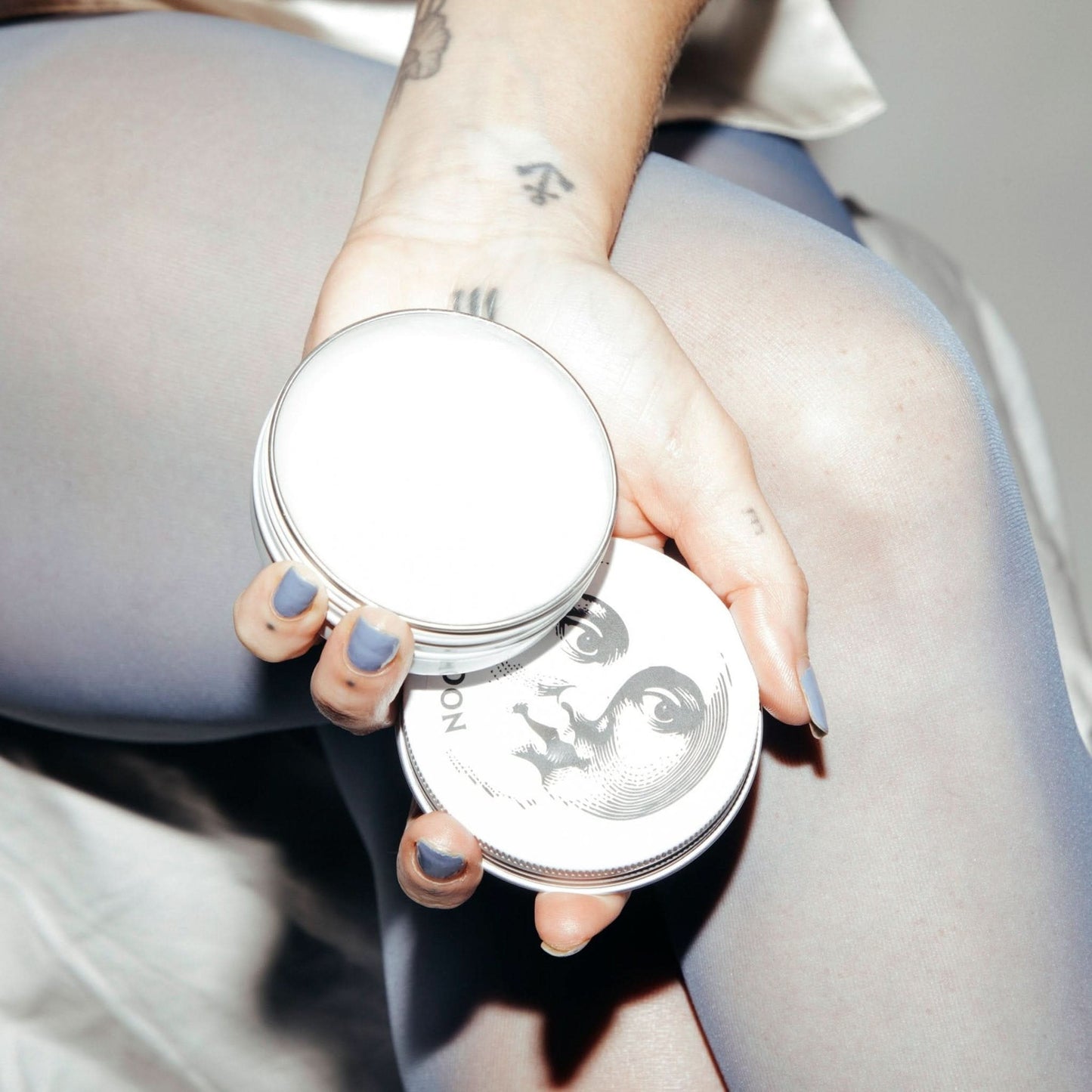
Anhydrous, 15 ingredients, no water, no fragrance, no preservatives, no menthol or camphor. MCT oil and squalane drive the 60 to 90 second absorption. Shea butter and beeswax provide the breathable barrier that protects against further wet-dry cycling. Bisabolol, calendula, plantain leaf, and helichrysum support the inflammatory response when skin is already irritated. Apply preventatively from the first day of a cold, flu, or hayfever flare. A small amount, thin layer, three or four times a day. Reapply after blowing your nose. Full ingredients here.
It also works on the chapped lips that develop alongside the under-nose damage in the same week, the dry skin that develops on the corners of your mouth from mouth-breathing while you sleep, and the cuticles that get cracked from the dry indoor heating you've been hiding under for a week.
What this article isn't covering
Anything happening inside your nose, including dryness, cracking, or bleeding inside the nasal cavity, isn't a skincare conversation. It's a conversation with a GP or pharmacist who can recommend the right saline gel, prescription rinse, or treatment for whatever's actually causing it. Decongestant rebound (rhinitis medicamentosa) in particular often needs medical support to break the cycle. NOOKS is for the external skin only, and we won't give you guidance on intranasal use.
If you're using a CPAP, on oxygen therapy, or recovering from sinus surgery, your medical team is the right place for guidance on managing nasal dryness. The external skin around your nose still benefits from a barrier balm, but that's a conversation about skincare alongside your medical care, not instead of it.
The shift
The skin under your nose is the most ignored, most damaged patch of face during any cold, flu, or hayfever week. Treat it preventatively from day one with the right product and you skip the cracked, raw, stinging phase entirely. Treat it reactively after it's already wrecked and you'll be in the same place the rest of your face is in by Friday: visibly recovered.
Balm without the petrol. Actives without the sting. No off limits.
$39.95. One tin. Shop NOOKS Everywhere Balm™.