What pregnancy and postpartum actually do to your skin, and what topicals can and can't fix.
Share
Pregnancy and the postpartum year are two of the most demanding periods a body's skin will ever go through. The skincare industry knows this. There's an entire shelf of products marketed specifically at the pregnant or postpartum body, most of them promising results that no topical product can actually deliver.
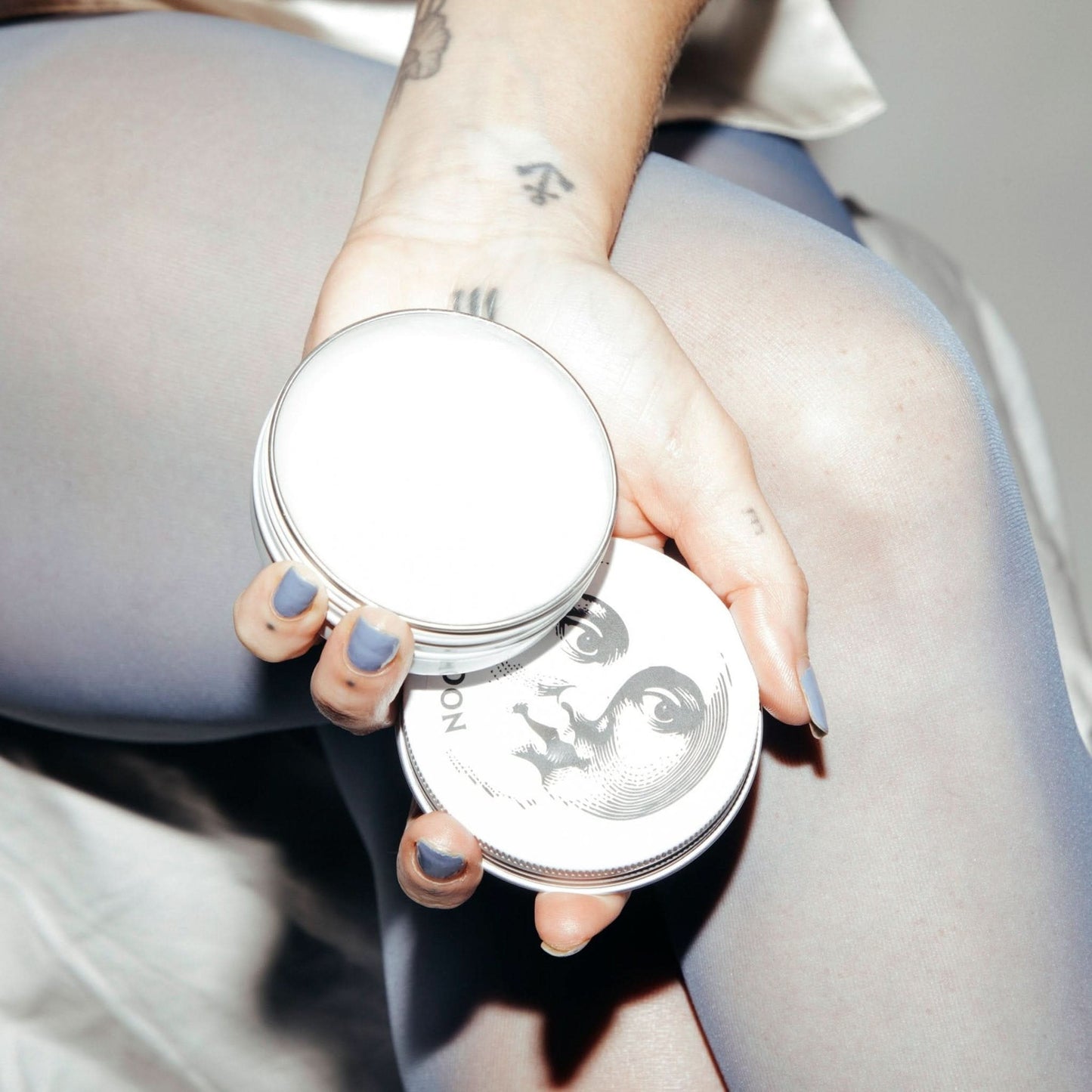
This is the honest version. What's happening in pregnant and postpartum skin, what's worth doing about it, what's not worth doing, and where products like NOOKS Everywhere Balm™ legitimately fit. Some of this won't be what the cocoa butter ads have been telling you for the last forty years.
What's actually changing in pregnant and postpartum skin
Three categories of change, all running in parallel from roughly the second trimester through the first postpartum year:
Hormonal
Oestrogen, progesterone, and prolactin levels shift dramatically and stay shifted. The visible effects on skin include: increased melanin activity (the linea nigra, melasma, darker areolae), shifts in sebum production (some people get the "pregnancy glow," others get the worst breakouts of their life), and changes in skin reactivity. Skin that tolerated certain products pre-pregnancy may suddenly react. Skin that was reactive may calm down. Both directions happen, and predicting which is impossible.
Mechanical
The abdomen, hips, breasts, and thighs stretch faster than skin's structural elasticity is calibrated for. This is the territory of stretch marks (striae gravidarum), itchy stretched skin, and the daily reality of clothes fitting differently every two weeks. Hands take more punishment from washing, sterilising, and hand sanitiser exposure. The perineum, in vaginal birth, undergoes acute mechanical trauma that takes weeks to surface-heal and longer to fully recover.
Environmental
New mothers wash their hands more times in a day than most adults do in a week. Nappy changes, bottle washing, sterilising equipment, the endless drying of small clothes. Lips crack from dehydration that's hard to stay on top of. The chest develops sweat-related irritation under nursing pads or during the temperature swings of recovery. Cuticles split. Every part of the body that wasn't directly involved in growing or feeding a baby is still being recruited to support the parts that are.
The stretch mark conversation, honestly
Most stretch mark products promise prevention. Most of them don't deliver it. Here's why.
Stretch marks are dermal-layer scarring. They form when skin stretches faster than the collagen and elastin in the dermis can accommodate, causing micro-tears below the surface. The visible mark is the body's healing response to those tears, expressed through the upper layers as a coloured line that fades but rarely disappears.
Topical products operate primarily on the stratum corneum and upper epidermis. The dermis sits below that, and the structural damage of striae happens there. Nearly every clinical review of stretch mark prevention products has reached the same conclusion: cocoa butter, vitamin E oil, almond oil, and most other proprietary blends show no statistically significant prevention effect compared to placebo. Some studies show modest benefit from products containing centella asiatica or hyaluronic acid in specific formulations, but the effect sizes are small and the methodology often weak.
This isn't a limitation of NOOKS specifically. It's a limitation of topical skincare as a category. No balm reliably prevents or treats stretch marks. Anyone telling you their product does is making a claim the clinical literature doesn't support.
Brennan M, et al. Topical preparations for preventing stretch marks in pregnancy. Cochrane Database Syst Rev. 2012;11:CD000066.
Korgavkar K, Wang F. Stretch marks during pregnancy: a review of topical prevention. Br J Dermatol. 2015;172(3):606-615.
What balms can actually help with during pregnancy
Most of what people buy stretch mark cream for isn't actually about stretch mark prevention. It's about the daily discomfort of stretched skin. That part topicals genuinely help with.
— Itching from stretched skin. Tight, expanding skin gets itchy. A lipid-rich balm reduces the surface tightness and the itch significantly.
— Dryness on the abdomen, breasts, and thighs as they expand. The stretching alone seems to deplete surface lipids faster than the skin can replace them.
— Comfort under clothing. Stretched skin can be reactive to fabric friction. A barrier balm reduces that interface.
So if you've been buying stretch mark cream and finding it useful, what you've really been buying is a barrier balm. The stretch mark prevention claim is probably not why it's working for you.
The other skin that takes a beating
Stretch-prone skin gets all the attention. The actually-suffering skin is usually elsewhere.
Hands
New parents wash their hands an average of 30 to 50 times a day. Cracked knuckles, raw cuticles, and dry palms by week two are nearly universal. The lipid stripping is constant and the recovery time is non-existent.
Lips
Pregnancy and postpartum dehydration, mouth-breathing during exhausted sleep, and the cumulative effect of less self-care time mean lips crack and split routinely. Most lip balms are fragranced or contain menthol, which sting on already-cracked lips.
Chest and breasts
Whether or not someone is breastfeeding, the chest and breast skin take environmental damage during the postpartum year. Sweat under nursing pads, friction from new bra sizes, dryness from showers taken in two-minute windows. The skin between and below the breasts is often the most overlooked irritation zone in the entire postpartum body.
Perineum (healed)
After perineal healing has surface-completed (typically 4 to 6 weeks postpartum, longer for tearing or episiotomy), the surrounding skin often stays reactive for months. Daily comfort care on healed perineal tissue is one of the legitimate use cases for a mucosal-safe balm. (Acute perineal recovery in the first few weeks is medical territory, not skincare.)
Under-eyes
The most visibly tired skin on a new parent. No topical product fixes sleep deprivation, but daily lipid support keeps the surface from cracking, peeling, or developing the dry texture that exhaustion alone produces.
Cuticles
Sterilising bottles, repeated handwashing, and dish soap all destroy cuticles. By week six postpartum, cuticles are often the worst-treated skin in the household.
What to look for in a product through pregnancy and postpartum
Pregnant and postpartum skin is more reactive than pre-pregnancy skin in most cases. The product needs to give you less to react to, not more. Things to look for:
— Anhydrous (no water phase). Means no preservatives required, which removes the most common cause of cosmetic contact dermatitis from the formula entirely.
— Fragrance-free. Pregnancy heightens olfactory sensitivity for many people, and reactive skin reacts to fragrance more readily. Removing it is a low-cost, high-benefit move.
— Skin-identical lipids. Squalane, jojoba, shea butter integrate into the barrier rather than sitting on top. For skin under daily mechanical and environmental stress, structural lipids do more than occlusive films.
— Food-grade ingredient profile. Useful in any context where the product may end up incidentally on hands that touch a baby, near a feeding zone, or close to mucosal areas. Not the same as "safe to feed an infant directly," but a meaningful safety floor.
— No essential oils above 1%. Many essential oils that are fine for general skincare have specific cautions in pregnancy. A formulation that keeps any aromatic botanicals well below sensitisation thresholds avoids the question entirely.
Where NOOKS Everywhere Balm™ fits
Anhydrous, 15 ingredients, no water, no preservatives, no fragrance, no synthetic essential oils. Food-grade ingredient profile throughout. The lipid stack (MCT, squalane, jojoba, shea, beeswax) absorbs in 60 to 90 seconds and supports the structural lipid load that pregnant and postpartum skin needs more of. The botanical actives (calendula, plantain leaf, helichrysum, bisabolol, marshmallow root) support the skin's own inflammatory response when the daily routine gets too heavy. Full ingredients here.
Use cases NOOKS is suitable for during pregnancy and postpartum
— Stretching abdomen, breasts, hips, thighs through pregnancy, for the comfort and itch-reduction reasons named above. Not as a stretch mark preventative, because no topical product reliably is.
— Hands, daily, for the constant washing damage.
— Lips, daily, for the cracked-lip stage that nearly everyone goes through in the postpartum weeks.
— Chest and breast skin, for friction and sweat-related irritation between feeds or under bras.
— Healed perineal skin (typically 4 to 6 weeks postpartum onwards), for daily comfort on skin that stays reactive long after surface healing has completed.
— Under-eyes, cuticles, and any other small zone of skin that's running on the lowest priority on the household roster.
What NOOKS isn't for in this phase
Two areas need explicit deference, not because the product is unsafe but because the use case is genuinely outside what cosmetics are appropriate to recommend on:
— Cracked or bleeding nipples, ongoing breastfeeding pain, latch issues, or nipple thrush. These are lactation consultant territory. A qualified IBCLC (International Board Certified Lactation Consultant) can assess what's actually causing the problem and what's appropriate to put on the nipple given your specific situation. Australian Breastfeeding Association runs a free national helpline (1800 686 268) for mothers who can't access private support. Whatever a lactation consultant or GP recommends takes priority over anything a skincare brand says.
— Acute perineal trauma, suspected mastitis, suspected infection of any kind, or any wound that isn't surface-closed. These are medical situations, not skincare ones. See your GP, midwife, or maternal-child health nurse.
This isn't NOOKS being cautious for legal reasons. It's the difference between what a cosmetic balm is suitable for and what a person under medical care actually needs. The two don't overlap as much as the marketing on most postpartum products suggests they do.
The bigger frame
Pregnancy and postpartum skin isn't a problem to be fixed. It's a phase the body is going through, and like every other phase of skin's life, it benefits from lighter routines, fewer ingredients, and consistent support rather than heavy-handed intervention.
The skincare industry has spent forty years selling pregnant and postpartum people elaborate routines, expensive proprietary blends, and unsubstantiated promises about reversing what the body is doing on purpose. The honest answer is simpler. Look after the skin that's actually struggling (hands, lips, chest, healed perineal, under-eyes). Skip the products making claims they can't substantiate. Defer to medical professionals for medical issues. Get through the year.
Balm without the petrol. Actives without the sting. No off limits.
$29.95. One tin. Shop NOOKS Everywhere Balm™.