18 beloved products that are mostly water and crude oil.
Share
Petrolatum goes by five different names. It's refined from crude oil. And it's the #1 or #2 ingredient in some of the most recommended, most trusted, most gifted skincare products on earth. We went looking. Here's what we found.
Before we start: a note on what this is and isn't.
This is not a hit piece on petroleum jelly.
Petrolatum is one of the most well-studied ingredients in cosmetic history. It is effective. It is well-tolerated. For wound care, post-procedure skin, and acute barrier disruption, it has genuine clinical value. Dermatologists recommend it for good reason.
This article is about something different: the gap between what these products say and what they contain. The marketing language around "hydration," "nourishment," "barrier repair," and "natural origin" — applied to products where the primary active is a petroleum derivative — deserves scrutiny. Not because petroleum jelly is poison. Because you deserve to know what you're paying for, what you're actually putting on your skin, and how to layer products intelligently when you understand what each one does.
Petrolatum seals. It does not rebuild. Those are different jobs. Knowing which one you need changes everything.
What petroleum is actually doing in your skincare.
Petrolatum is an occlusive. It sits on the surface of the skin and physically reduces water loss — by approximately 98%, the highest occlusive efficiency of any cosmetic ingredient ever measured. Nothing does this job more effectively. That's the science. That's not contested.
The limitation is not what it does. It's what it can't.
Your skin barrier is a living, manufactured structure — ceramides, cholesterol, and fatty acids arranged in precise lamellar layers that your body synthesises, replenishes, and regulates in response to its own internal signals. Petrolatum is a hydrocarbon. It has no metabolic entry point into that system. It cannot be incorporated into your lipid lamellae. It sits between skin cells, provides a physical seal, and when you remove it or stop applying it, it's gone. Nothing has been rebuilt. Nothing has been deposited. Your skin is exactly as it was underneath — minus the water it retained while the product was on.
This is the distinction that matters: sealing versus rebuilding. For acute protection — a wound, a burn, a compromised barrier needing immediate relief — sealing is exactly right. For skin that is chronically dry, reactive, or depleted, an approach that only seals never addresses the underlying deficit.
Biomimetic plant lipids work differently. Squalane is structurally identical to squalene, a molecule that makes up roughly 10–13% of your own sebum. Jojoba's wax esters closely mirror the wax ester fraction of human sebum. Shea's fatty acids can be incorporated into the lamellar body pathway. These ingredients supply raw materials your skin can actually use — not just a surface that mimics the job your skin is supposed to do itself.
One approach substitutes for your barrier. The other supports it.
The synonym problem. This is the part the industry is counting on you not knowing.
Most people know to look for "petrolatum" on an ingredient list. That word appears in fewer than half the products below.
Petrolatum and its petroleum-derived relatives appear under at least nine different names in products sold in Australia:
- Petrolatum — the semi-solid form; what Vaseline is
- White petrolatum — USP pharmaceutical-grade petrolatum, used in regulated drug products
- Petroleum jelly — the consumer name for the same molecule
- Paraffinum liquidum — the INCI Latin name for mineral oil, the liquid petroleum fraction
- Mineral oil — the English name for paraffinum liquidum
- Huile minérale — French for mineral oil, used on multilingual EU/AU labels
- Liquid paraffin — pharmaceutical name for mineral oil, common on Australian and UK packaging
- Cera microcristallina / Microcrystalline wax — a semi-solid petroleum wax used as a thickener
- Paraffin / Paraffin wax — the solid petroleum fraction used to set consistency in balms and sticks
All petroleum-derived. All from the same crude oil vacuum-distillation process. A consumer scanning a label for "petrolatum" will miss every product that uses the Latin, French, liquid, or wax form instead. That is not an oversight in labelling law. It is how the category has always worked.
Quick-reference table
| Ingredient name | What it is | Form |
|---|---|---|
| Petrolatum | Petroleum jelly | Semi-solid |
| White petrolatum | USP-grade petrolatum | Semi-solid |
| Paraffinum liquidum | Mineral oil | Liquid |
| Mineral oil | Paraffinum liquidum | Liquid |
| Huile minérale | Mineral oil (French) | Liquid |
| Liquid paraffin | Mineral oil (pharma) | Liquid |
| Cera microcristallina | Microcrystalline wax | Semi-solid |
| Paraffin / Paraffin wax | Petroleum wax | Solid |
The co-dependency loop. A theory — but a coherent one.
Your skin uses transepidermal water loss as its own internal manufacturing signal. When water escapes through a damaged or depleted barrier, that signal triggers the upregulation of lipid synthesis — more ceramides, more cholesterol, more fatty acids. The barrier rebuilds itself. This is the mechanism. It is well-documented.
What happens when you fully seal that signal for long periods is less settled. Studies using fully impermeable films — latex membranes, Saran-type occlusion — showed suppression of the enzymes responsible for cholesterol and ceramide synthesis. The skin stopped manufacturing because the signal was removed. Importantly, those studies used impermeable films, not petrolatum specifically — and a landmark 1992 paper established that petrolatum actually permeates the intercellular spaces of the stratum corneum rather than forming an impermeable surface film, meaning normal barrier recovery continues under petrolatum use.
This article does not claim petrolatum causes dependency. What it does observe: a product that provides only physical occlusion, without supplying raw materials the skin can incorporate into its own lipid structure, is offering temporary comfort without regeneration. The more you depend on an external seal for baseline skin comfort, the less your skin is called upon to do that work itself. Whether that constitutes dependency is still being worked out. Whether petrolatum rebuilds anything is not — it doesn't.
The layering note. Because this changes how you use everything.
Understanding what petroleum-based products do changes how you use them.
Petroleum occlusives seal the surface. Anything applied on top of a petroleum base cannot penetrate. If your botanical balm, ceramide serum, or hyaluronic acid goes on after a petroleum-dominant product, it is sitting on the outside of a seal — not reaching your skin.
The correct order: actives and treatments first, occlusive last. The occlusive locks in what's underneath. If the occlusive goes first, there is nothing to lock in and nothing that follows can get through. This applies to layering any occlusive-heavy product — petroleum-based or not.
The 18 products.
Real products. Real ingredient lists. Every figure comes from regulatory drug labels, brand-published INCI lists, or the INCIDecoder database, cross-referenced to a second source. Formulations change — always verify current packaging.
Vaseline Petroleum Jelly. 100% petrolatum. The original. Every other product on this list is a variation on the same molecule. Vaseline makes no claims to be anything else — which makes it the most honest product here.
Lucas' Pawpaw Ointment. Approximately 96% petroleum jelly. Less than 4% paw paw extract. The fruit is in the name. The petroleum is in the formula. What you are buying is a petroleum jelly with excellent branding.
Aquaphor Healing Ointment (Beiersdorf). Petrolatum at 41% — the listed active ingredient. Mineral oil at #2. Lanolin at #3. Marketed as the #1 dermatologist-recommended brand for dry skin. For wound care and post-procedure skin, it is clinically appropriate. For daily moisturisation, it is petroleum jelly with clinical language on the label.
CeraVe Healing Ointment (L'Oréal). Petrolatum 46.5% — the first ingredient by weight. Mineral oil at #2. Paraffin at #3. The ceramides CeraVe is known for appear after three petroleum-derived ingredients. Carries the National Eczema Association seal. The ceramide brand is built on a petroleum base.
Elizabeth Arden Eight Hour Cream. Petrolatum 56.8% — on the regulated FDA drug label. Lanolin at #2. Mineral oil at #3. Retailing at approximately $44 USD. Over half petroleum jelly by weight. The "secret of makeup artists since 1930" is crude oil, refined.
Glossier Balm Dotcom. Petrolatum is the #1 ingredient. Described as "packed with antioxidants and natural emollients." Lanolin, a known allergen, at #4. The entire millennial-skincare-first identity of the brand sits on the same molecule as Vaseline.
Embryolisse Lait-Crème Concentré. Paraffinum liquidum — mineral oil — is ingredient #2, behind water only. Marketing foregrounds "natural origin" ingredients: shea butter, beeswax, aloe vera, soy proteins. Mineral oil is not on that list. It is in the formula. EWG rates this product as high hazard. The cult Paris pharmacy status is real. The mineral oil is also real.
Avène Cold Cream. Paraffinum liquidum is the #1 ingredient — listed above water. A water-in-oil emulsion, meaning petroleum is the dominant phase. Marketed for children and babies. Avène's brand identity is built on thermal spring water. Their Cold Cream's primary ingredient is mineral oil.
Avène Cicalfate Restorative Skin Cream. Paraffinum liquidum at position #3. The same ingredient appears in three languages on one line: Mineral Oil / Huile Minérale / Paraffinum Liquidum. One petroleum-derived ingredient. Three names. Marketed as clinically proven to accelerate skin recovery by 2×.
Mustela Stelatopia Emollient Cream. Packaging reads "97% ingredients of natural origin per ISO 16128." Petrolatum is ingredient #3. ISO 16128 — the standard being cited — classifies certain petroleum-derived ingredients as natural origin under specific processing conditions. This is a contested classification within the cosmetics industry. Marketed for newborns with eczema-prone skin.
Bepanthen Baby Ointment (Bayer). Lanolin at #2. Paraffinum liquidum at #3. Petrolatum at #4. Three petroleum-adjacent ingredients in the top four. For the nappy area and breastfeeding mothers' nipples. Label states free from preservatives, colorants, and fragrances. Does not state free from petroleum.
Kiehl's Lip Balm #1 (L'Oréal). Petrolatum at #1. The product page leads with "renewable squalane, a highly-refined botanical lipid derived from plants." Squalane is a genuinely good ingredient. It is the second ingredient. Petroleum jelly is the first.
Smith's Rosebud Salve. Petrolatum at #1. Cotton seed oil at #2. Sold at Sephora. Formulated in this format since 1895. The rosebuds are on the tin. The petrolatum is in it.
Carmex Classic Medicated Lip Balm. White petrolatum at 45.3% per the drug label. The "medicated" refers to camphor, menthol, and salicylic acid. Petroleum jelly is the vehicle they arrive in.
ChapStick Classic Original (Haleon). White petrolatum 45% — the regulated active ingredient. Light mineral oil and paraffin also in the formula. The world's bestselling lip balm. Called Classic because the formula hasn't meaningfully changed since the 1880s.
Bioderma Atoderm Intensive Baume. Paraffinum liquidum at position #3. Marketed as ultra-soothing, ultra-nourishing care for eczema-prone skin with specific language around microbiome support. The microbiome language is in the marketing. The mineral oil is in the base.
Sudocrem Care & Protect. Petrolatum in the formula. Paraffinum liquidum also in the formula. Lanolin and dimethicone alongside. Zinc oxide as the active ingredient. Four non-botanical occlusives in one product. Zinc on top of petroleum.
Nivea Creme (Beiersdorf). This one deserves a longer look.
The Australian formula — verified directly on nivea.com.au — lists: Aqua, Paraffinum Liquidum (#2), Cera Microcristallina (#3), Glycerin, Lanolin Alcohol (#5), Paraffin (#6). Three petroleum-derived ingredients and one animal-derived ingredient in the top six.
On the same product page, under "Does not contain," Beiersdorf lists: Ethyl Alcohol, Microplastics, Animal or Animal-derived Ingredients.
Lanolin Alcohol is ingredient #5. Lanolin is extracted from sheep's wool. It is, by definition, an animal-derived ingredient. That is not a synonym problem. That is not a regional formulation nuance. That is a factual contradiction between two sections of the official Australian Nivea website — verifiable by anyone with a browser right now.
The petroleum has been in this tin for over 100 years. The marketing has been telling a different story the whole time.
A note on drying alcohols — since we're reading labels now.
A separate pattern emerged while reviewing these formulations: drying alcohols appearing in products marketed for dry, sensitive, or compromised skin.
First, a distinction that matters. There are two entirely different categories of alcohol in cosmetics and they behave in opposite ways.
Fatty alcohols — cetyl alcohol, stearyl alcohol, cetearyl alcohol, behenyl alcohol — are not drying. They are emollients and emulsifiers derived from plant or animal fats. They soften skin and give creams their texture. If you see these, leave them alone.
Drying or simple alcohols — ethanol, alcohol denat, SD alcohol, isopropyl alcohol — are solvents. At significant concentrations and with regular use, they disrupt the stratum corneum lipid structure and increase transepidermal water loss. They are added to products to create fast-dry finishes, lightweight textures, and quick absorption. The skin pays for the sensory experience.
These appear in toners, essences, serums, lightweight moisturisers, and hair products marketed specifically for reactive, sensitive, or oily skin — the skin states most vulnerable to barrier disruption. If your skin feels tight after a "balancing" toner or your scalp is reactive to a "smoothing" treatment, check the ingredient list for alcohol denat or ethanol in the first five positions.
How to actually read a label.
Position matters. Ingredients are listed in descending order of concentration. Water is almost always first. The interesting information starts at #2. If a petroleum-derived ingredient appears in positions two through six, it is a primary ingredient regardless of what the front of the pack says.
Know the petroleum synonyms. Petrolatum, white petrolatum, paraffinum liquidum, mineral oil, huile minérale, liquid paraffin, cera microcristallina, microcrystalline wax, paraffin. Any of these early in the list means petroleum is doing the heavy lifting.
Know the alcohol distinction. Cetyl, stearyl, cetearyl, behenyl — fine. Ethanol, alcohol denat, SD alcohol, isopropyl — note where they sit in the list.
Read claims against lists. "Natural origin," "plant-based," "nourishing," "barrier repair" — marketing categories, not regulatory definitions. The ingredient list is the legal document. The front of the pack is advertising. Cross-reference both.
Verify "free from" claims against the ingredient list. "Free from mineral oil" does not mean free from paraffinum liquidum. "Free from animal-derived ingredients" should mean no lanolin — check that it does.
What to do with this.
Nothing on this list is a scam in the criminal sense. These are legal products with disclosed ingredients. Petrolatum does what it says it does. The products work — within the limits of what occlusion can do.
What this list is: a case for reading the back of the pack before the front. A reminder that "dermatologist recommended," "natural origin," "97% plant-based," and "barrier repair" are marketing categories with no universal regulatory definition. A demonstration that the same crude oil derivative can be named nine different ways across eighteen different products and never once be called what it is.
Your skin has its own repair mechanisms, its own lipid synthesis pathways, its own response to damage. The question worth asking of any product is not just "does this feel good" but "is this supporting what my skin already knows how to do — or is it doing the job instead?"
Both have their place. Knowing which you need is the point.
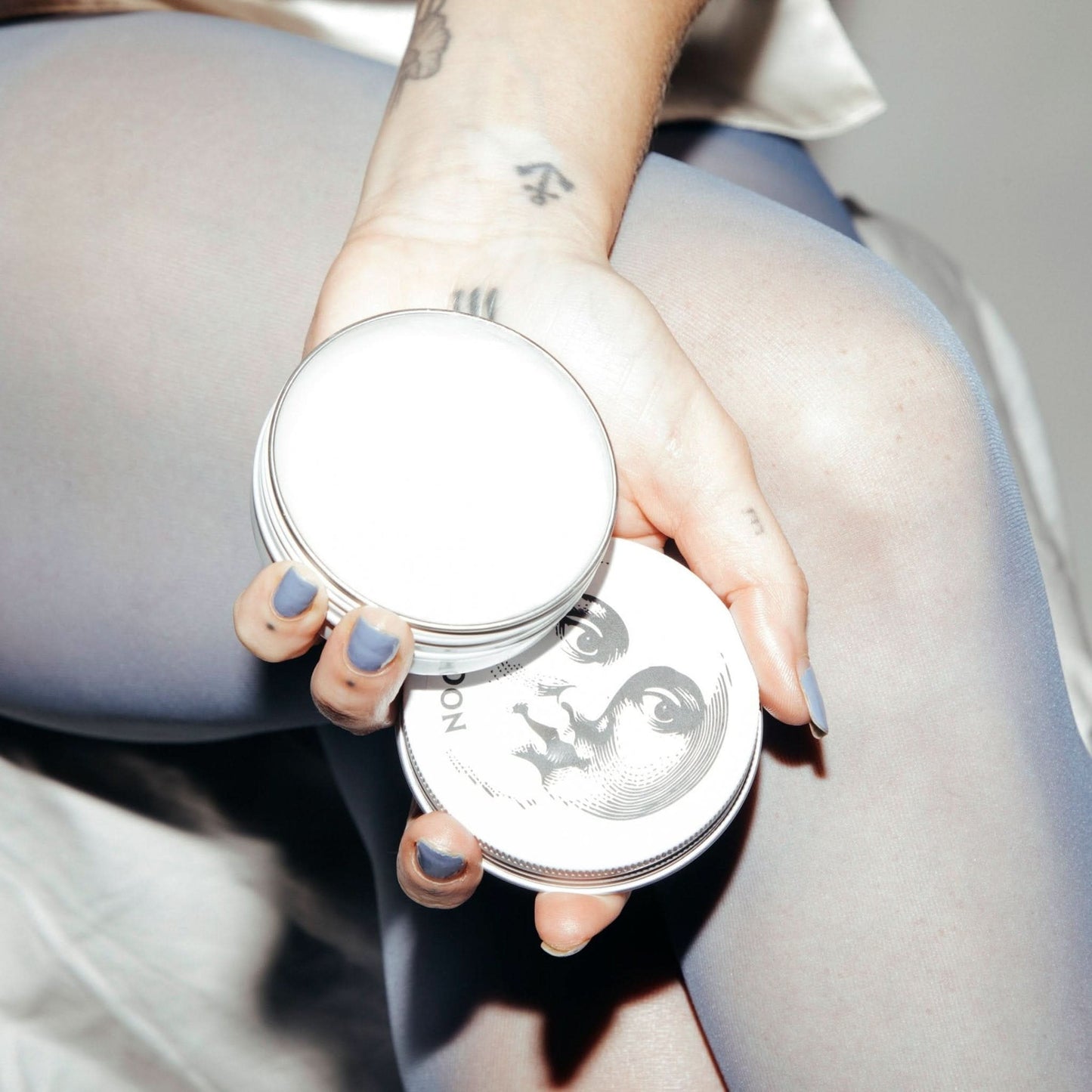
NOOKS Everywhere Balm is anhydrous, petroleum-free, and formulated from 15 botanical ingredients. It does not claim to heal, treat, or fix your skin. It supports what your skin is already trying to do.
says very little. does quite a lot.
Born in Melbourne.