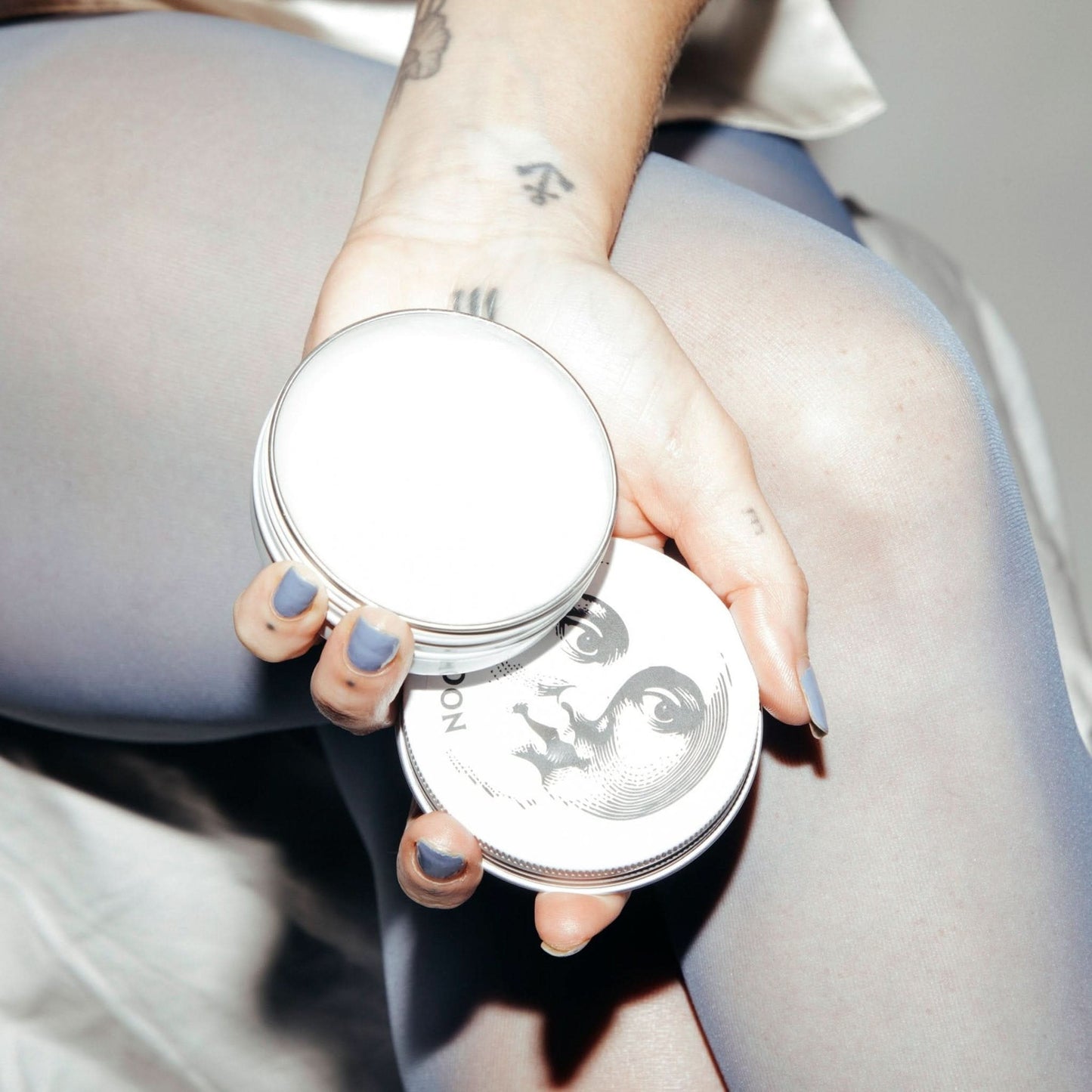
Most skincare is mostly water and petroleum.
Ours is neither.

MCT
Fast-absorbing carrier. Delivers actives into the skin within 90 seconds without leaving a film. The reason this tin doesn't sit on top of you.
Shea butter
Structural emollient. Supports barrier integrity and softens skin texture. Reduced from typical balm levels to keep finish soft-matte, not heavy.
Jojoba oil
Skin-identical wax ester. Integrates with the lipid barrier rather than coating it. Breathable, non-comedogenic.
Calendula
Anti-inflammatory botanical, infused into sunflower oil. Long evidence base for compromised and post-trauma skin.
Beeswax
Edible-grade occlusive. Holds the formula together and seals what's underneath. No petroleum required.
Squalane
Olive-derived. The reason absorption is fast and finish is matte. Skin-mimetic, lightweight, non-greasy.
Marshmallow root
Mucilaginous botanical infused into oil. Reduces friction on mucosal tissue. Why this tin is rated for use, yes, even there.
Plantain leaf
Wound-healing botanical with antimicrobial activity. Studied for minor abrasions, bites, and compromised skin.
Vitamin E
Tocopherol. Antioxidant. Stabilises the unsaturated oils and supports barrier repair.
Monolaurin
Food-grade antimicrobial derived from coconut. Reduces microbial pressure without disrupting the skin's own microbiome.
Manuka oil
Food-grade, micro-dosed. Gentle antimicrobial protection. Below the threshold that causes scent or warmth on mucosal tissue.
Bakuchiol
Plant-derived. Comparable to retinol in peer-reviewed studies for barrier repair and tone, without the irritation profile. Within the clinically studied range.
Bisabolol
Anti-inflammatory active derived from chamomile. Reduces redness and reactivity. Mucosal-safe.
Helichrysum
CO₂-extracted. Supports tissue regeneration. Clinically relevant at low dose, which is where it sits.
Sunflower oil
The carrier for the calendula infusion. High-linoleic, barrier-supporting on its own.
Why no petroleum or water?

Petroleum is occlusion pretending to be treatment.
No antimicrobial support. No anti-inflammatory action. No tissue repair. Just a seal that stains everything and can trap bacteria near vulnerable tissue.
For lips: creates dependency. Your skin stops doing the work.
For intimate areas: sits on top, and degrades latex.
For eczema: comfort while it's on. Nothing underneath.

Water is dilution pretending to be hydration.
In a balm, water is dilution pretending to be hydration.
Most creams are 75% water. It evaporates within minutes of touching your skin. What it leaves behind is a thinned-out active
stack held together by preservatives the formula only needs because the water was there in the first place.
Emulsifiers to bind it. Stabilisers to hold it. The formula gets bigger. The skin gets less.
Water has a job. Most formulas don't give it one. Here, there was nothing for it to do.